







https://philpapers.org/rec/HOOFGA
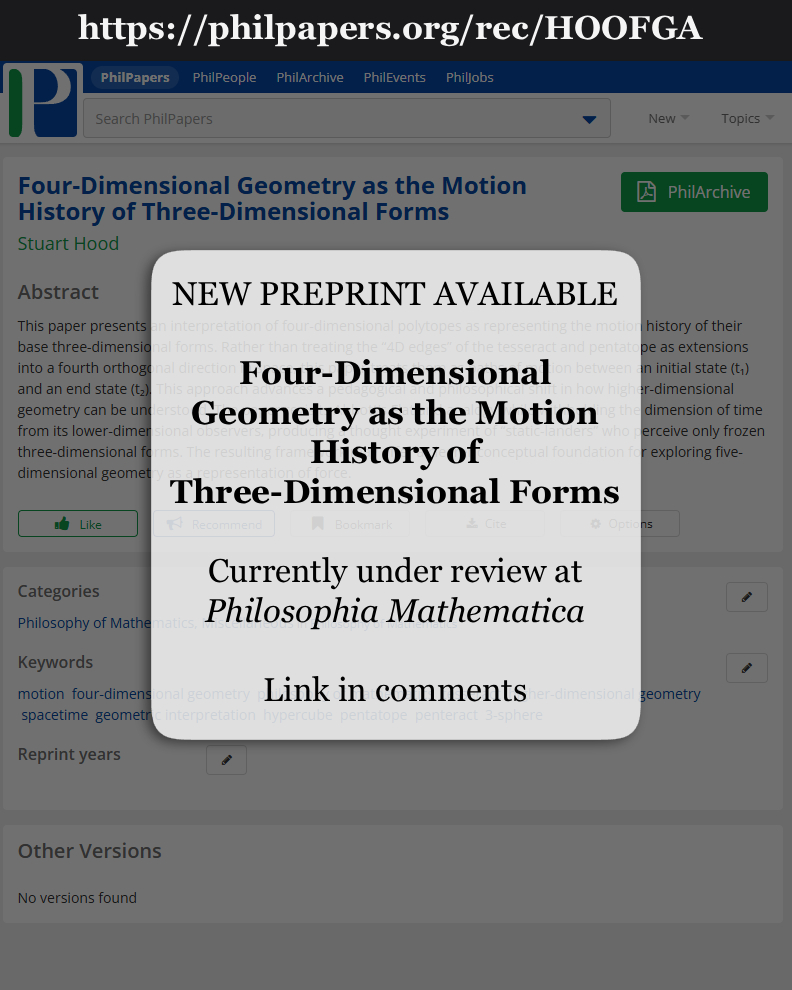
Four-Dimensional Geometry as the Motion History of Three-Dimensional Forms
Abstract
This paper presents an interpretation of four-dimensional polytopes as representing the motion history of their base three-dimensional forms. Rather than treating the “4D edges” of the tesseract and pentatope as extensions into a fourth orthogonal direction in space, this paper treats them as paths of motion between an initial state (t₁) and an end state (t₂). This approach advances a pedagogical and philosophical shift in how higher-dimensional geometry can be understood. The paper revisits Abbott’s Flatland analogy while withholding the dimension of time from its lower-dimensional observers, producing a thought experiment of “static-landers” who perceive only frozen three-dimensional forms. The resulting framework may offer a clearer conceptual foundation for exploring five-dimensional geometry as a representation of force.
Leave a Reply