







I have been working on a second edition of my book on motion as the fourth spatial dimension, and have since been refining its summary. Below is an in-depth overview of its main ideas:
Motion: The Fourth Spatial Dimension is a book that addresses and resolves an over century-old problem about the fourth spatial dimension, challenging the idea of it requiring a new static spatial axis as Charles Hinton proposed in 1888. A fourth dimension of time was popularized by Hermann Minkowski in 1908 and integrated into Albert Einstein’s relativity, showing practical application, but debates still spark about exactly what “the fourth dimension” is, particularly of space. Many point out that time is not spatial, and look to Hinton’s tesseract as the logical and mathematically-sound representation of a spatially four-dimensional progression of a three-dimensional cube.
Studies of the tesseract, however, demand very abstract thinking to fit contemporary interpretations of its logic: a fourth spatial axis that is orthogonal (at a new right angle) to the familiar three directions (width, length, height) of space. However difficult that is to conceive, mathematicians continue to run with it, even expanding to higher dimensions beyond, encouraged by the math and logic of Hinton’s recursive progression that led to the construction of the tesseract.
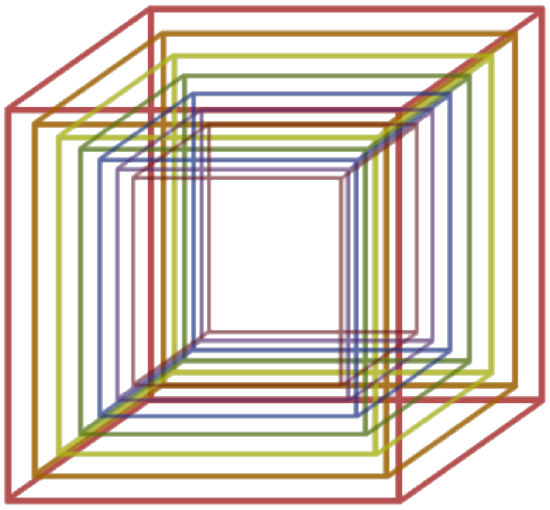
This book’s idea solves this discrepancy of a mysterious fourth spatial direction (which has really always been far beyond human comprehension), while also uniting the math and logic of Hinton’s tesseract with the ideas of Minkowski and Einstein. In the opening chapter, the author shows how the tesseract’s 3D projection (the familiar cube nested within a cube with all corners connected by “four-dimensional edges”) can perfectly represent what is proposed to be a fuller regard of the fourth spatial dimension: the motion of 3D forms. With one cube of the tesseract representing a single cube at one moment in time, and the other cube representing the same cube at a different moment in time, the connecting “four dimensional edges” can represent displacement vectors (paths of motion) through both space and time, along what could very well be termed a spacetime axis. This shows the tesseract to be what Minkowski termed a worldline, the four-dimensional history of an object through spacetime—in this case, the motion of a cube expanding or contracting.
This does not just apply to the tesseract; the author shows how the 3D projections of other 4D polytopes such as the 4-simplex and 3-sphere can be interpreted in the same way—a proposal that has never been published before which aligns seamlessly with the four-dimensional math and logic that has been developed over the years. The book then goes on to showcase the utility of 4D geometry in programming the motion of 3D forms, building on ideas that started in the 16th century, from D’Alembert to Lagrange and then to Möbius’ development of the homogeneous coordinate system that implements length, width and height with a fourth coordinate of time (x, y, z, t).
With this new groundwork in place (regarding the fourth spatial dimension as a capacity for motion that the existence of time enables), the book continues to propose further dimensional steps, showing a natural progression to be what is deeply tied to motion: force. Returning to Hinton’s recursive projection, beyond the 4D tesseract the 5D penteract is shown to embody the symmetrical dynamics of force, mirroring events of particle physics and celestial mechanics. This is not entirely new speculation, as tying force to a system of 5D geometry was attempted first by Kaluza-Klein theory, and then by its modern successor Space-Time-Matter Theory.
Beyond these ideas that seem to encapsulate the dynamics of all physical reality, from form (3D) to motion (4D) to force (5D), a further step is then proposed that bridges from spatial existence toward consciousness. This is through the consideration of not what does exist, but what can exist, through the concept of possibility (6D). This book explores this dimensional realm through the ideas of Hilbert space, alternate realities, entropy and the beginnings of computational epistemology that deal with the infinite algorithmic arrays that can be developed within any physical or lower-dimensional scenario.
From there, the book then proposes a final step that deals with the information that these endless scenarios present, through a conscious ability for intelligence (7D). Here, the massive data that comes from basic knowledge and observance of the world and its capabilities is processed through higher capacities of logic, reason, choice and will. The book will dive into the rich history of its study and consideration through philosophy, psychology and ethics—even looking at recent development of artificial intelligence to see where it might align with a seven-dimensional structure of existence.
While modern mathematicians and thinkers continue to advocate for a static fourth spatial axis to account for the math and logic of Hinton’s 4D tesseract, Motion: The Fourth Spatial Dimension redirects this longstanding search, pointing instead to what has been grossly overlooked: the animated, ever-moving world we live in. This perspective will set a new precedent across many academic fields, and bring higher dimensional thinking back into practical application, away from the unreachable abstractions that have dominated its study since the end of the 19th century.
Leave a Reply